
Implementation and Monitoring of Photovoltaic System Production at University locations
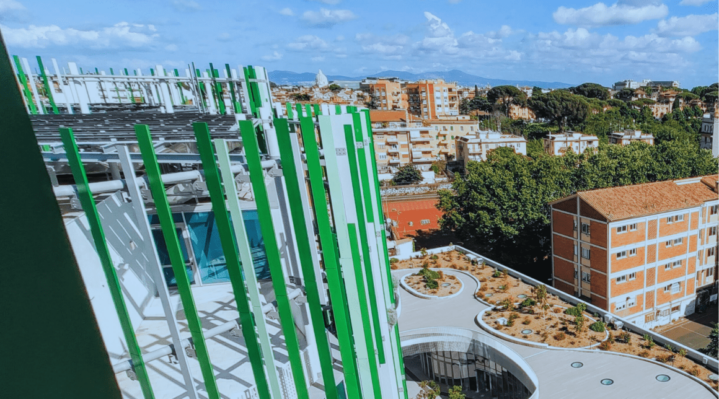
Roma Tre University has, for environmental sustainability purposes in the field of electricity, been working on multiple fronts. On one hand, it is committed to purchasing green energy from certified renewable sources; on the other, it is increasing the amount of electricity self‑produced by photovoltaic systems installed in various buildings.
There are currently two fully operational systems: one at the Via Volterra 62 site with approximately 25 kW and another at the Via Ostiense 133 site with approximately 101 kW.
A system at the Department of Law, with a capacity of 125 kW, was built during 2025 and will soon be connected.
Starting from 2023, the University commissioned a feasibility study to assess the possibility of installing photovoltaic systems at 11 University locations for a total nominal capacity of approximately 3,450 kW. Based on this study, a phased implementation plan has been launched which includes, during 2025, the construction of new systems at the following sites, for a total of approximately 946 kW:
- CHI 199 – Via Gabriello Chiabrera 199: 88 kWp
- VAL 019 – Via del Valco di San Paolo 19: 55 kWp
- OST 236 – Via Ostiense 230–238: 678 kWp
- OST 161 – Via Ostiense 159–165: 125 kWp
The energy production and the amount of CO₂ emissions avoided by the existing photovoltaic systems are constantly monitored.
Supply of Electricity and Natural Gas
Roma Tre uses electricity and natural gas as its main energy sources.
Roma Tre considers sustainability principles to be fundamental to all its planning activities; therefore, as with previous participation agreements, the University intends to activate the “Green Option”. Most of the electricity supply is provided by an external supplier offering 100% renewable‑source certified energy. This option requires that, pursuant to ARERA Resolution ARG/elt no. 104/11 and subsequent amendments, the electricity supplied comes exclusively from renewable sources and is certified with a Guarantee of Origin (GO). Roma Tre will therefore continue to use only electricity produced from non‑fossil renewable sources.
Electricity consumption in kWh:
- 2022: 18,320,590 kWh
- 2023: 16,203,357 kWh
- 2024: 15,386,040 kWh
- 2025: 15.551.759 kWh
The amount of electricity self‑produced via photovoltaic systems in 2025 was 124,807.17 kWh.
Natural gas consumption in November 2025: 208,697 m³

University Environmental Footprint
Regarding CO₂ emissions, the University’s estimated ecological footprint was calculated using the methodology recommended by Greenmetric (Greenmetric 2025 referring to the 2024 reporting year), which in turn is based on the calculation approach proposed by Carbon Footprint Ltd.
Recommended by UI GreenMetric
- CO2 (electricity)
= (electricity usage per year (kWh))/1000×0,84
= (15398703 kWh)/1000×0,84
= 12934,9 metric tons - CO2 (bus)
= (number of shuttle bus in your university × total trips for shuttle bus service each day × approximate travel distance of vehicle each day inside campus only (KM) ×240)/100×0,01
= (0 × 0 × 0 × 0)/100×0,01
= 0 metric tons - CO2 (cars)
= (number of cars entering your university × 2 × approximate travel distance of vehicle each day inside campus only (KM) ×240)/100×0,02
= (0 ×0 × 0 × 0)/100×0,02
= 0 metric tons - CO2 (motorcycle)
= (number of motorcycle entering your university × 2 × approximate travel distance of vehicle each day inside campus only (KM) ×240)/100×0,01
= (0 × 0 × 0 × 0)/100×0,01
= 0 metric tons
Carbon footprint in 2024 = 12934,9 metric tons